


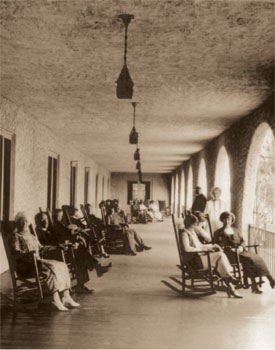
This veranda scene at a Florida hotel in the early 1920s typified the leisurely lifestyle that lured millions of tourists.
From the earliest days of European settlement, Florida has been regarded as a business venture. Pedro Menendez de Aviles, the explorer and colonizer who planted the Spanish flag here and established St. Augustine referred to it as “the enterprise of Florida.” And, what an enterprise it has been for the past 500 years!
Ponce de Leon, the discoverer of Florida, has entered popular legend as seeking a “fountain of youth” that would give those who drank from it eternal life and perpetual youth—a myth that is not backed by hard facts, but which endures nevertheless. Ponce’s legend set the standard for many of those who came after him and myths became an integral part of most promotional campaigns. The wilds of the Florida peninsula—a peninsula which was not completely surveyed until the early 19th century—held the prospect of always being something more than reality, and the mystery of the unexplored merely fueled the imaginations of those willing to be misled.
With its acquisition by the United States in 1821, a multitude of advertising campaigns were launched to bring settlers and tourists into what would later become known as the Sunshine State. With little in the way of manufacturing concerns and few mineral resources, early efforts to “sell” Florida centered on the state’s natural resources. Abundant wildlife, a balmy climate and the prospect of producing large and profitable crops were featured prominently in the millions of pamphlets and brochures sent out by agricultural associations, land developers and government agencies.
Read the entire article in the February 2008 issue





 True Tails is a series written by Amy Robinson for Vero Beach’s dog lovers. Ask Amy about your dog’s behavior by clicking below.
Facebook Comments