


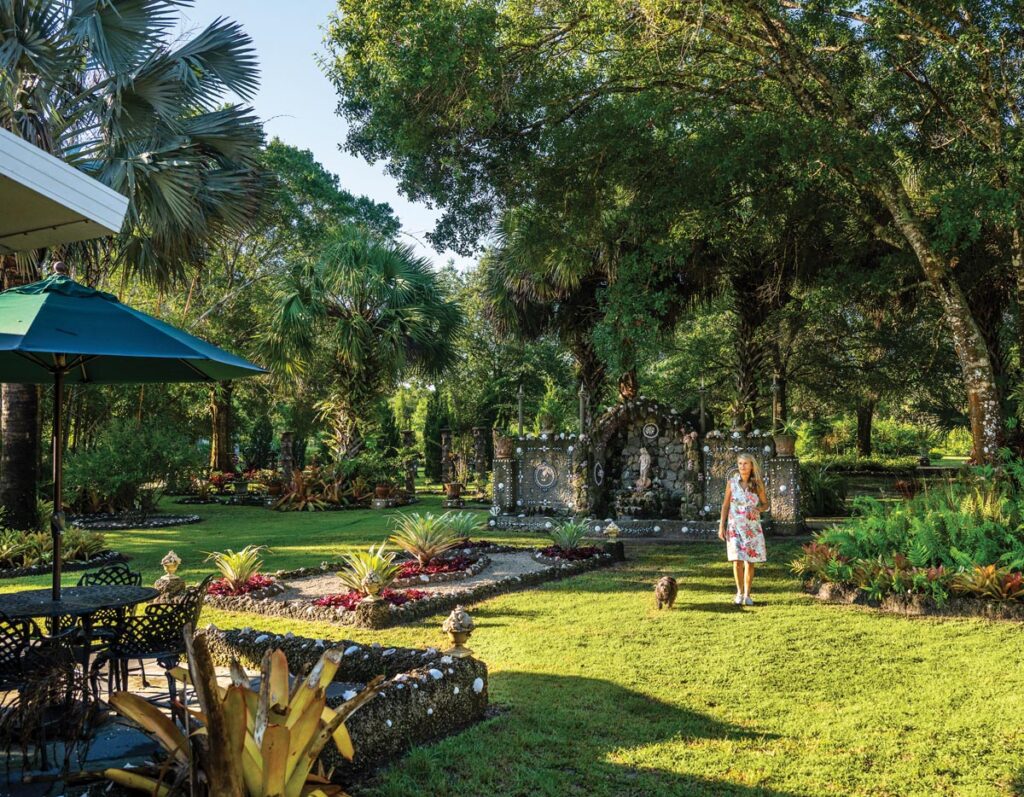
“I feel as if I’ve been transported to Italy.”
When people walk into her garden, look around, and make that statement, Cathi Bates knows she got it right. Inspired by historic gardens they have visited in Italy, she and her husband have transformed the grounds outside their Vero Beach home. It’s an ongoing labor of love that combines garden design, landscape architecture, and the cultivation of carefully chosen trees and flowers.
And it all began with a canceled vacation.
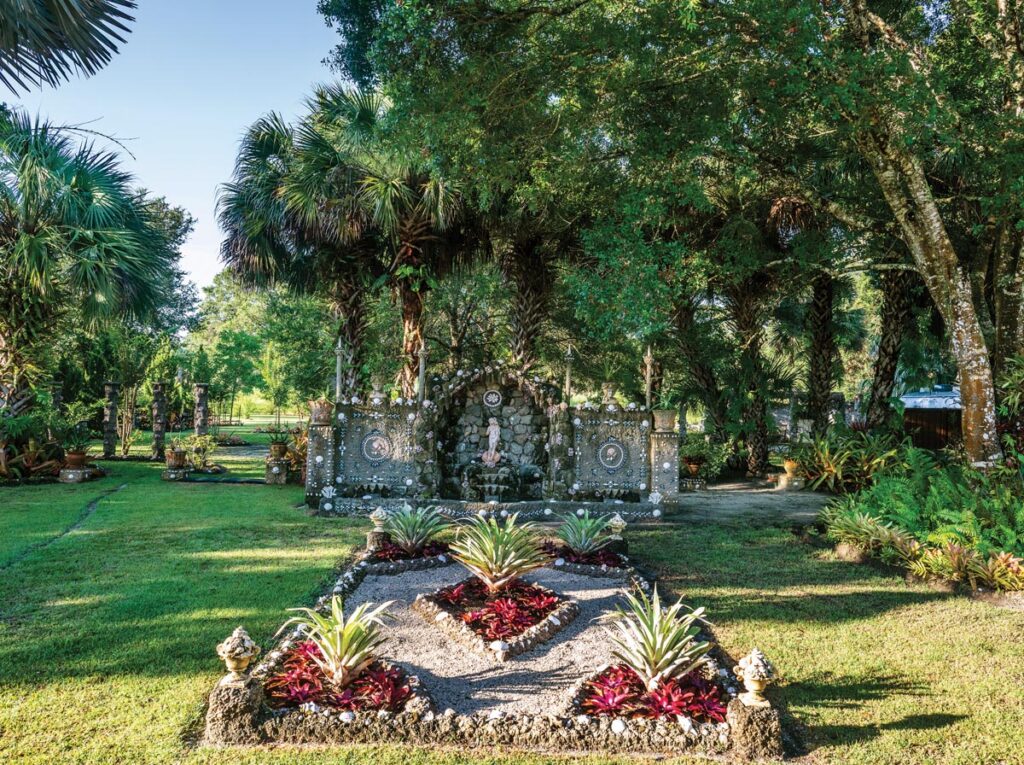
When the COVID pandemic forced them to cancel a trip to Italy, Cathi recalls, “Bob said we should plant an Italian garden and pretend we were in Italy. The next day, I started digging before he could change his mind—because he might have been kidding.”
Memories of previous trips afforded abundant inspiration. “We’ve been going to Italy for 30 years. We’ve also always gone to England, but English gardens don’t do so well in Florida.” Now, when Cathi and Bob travel, they have a new perspective because of their own garden. Cathi says with a sparkle in her eye, “Every time we go to Italy, the garden gets more elaborate when we return.” And while they do have a trusted gardener on hire, Cathi and Bob have done the bulk of the work themselves.
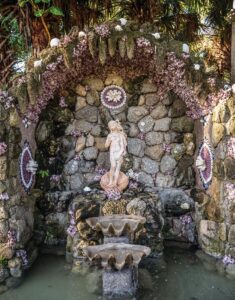
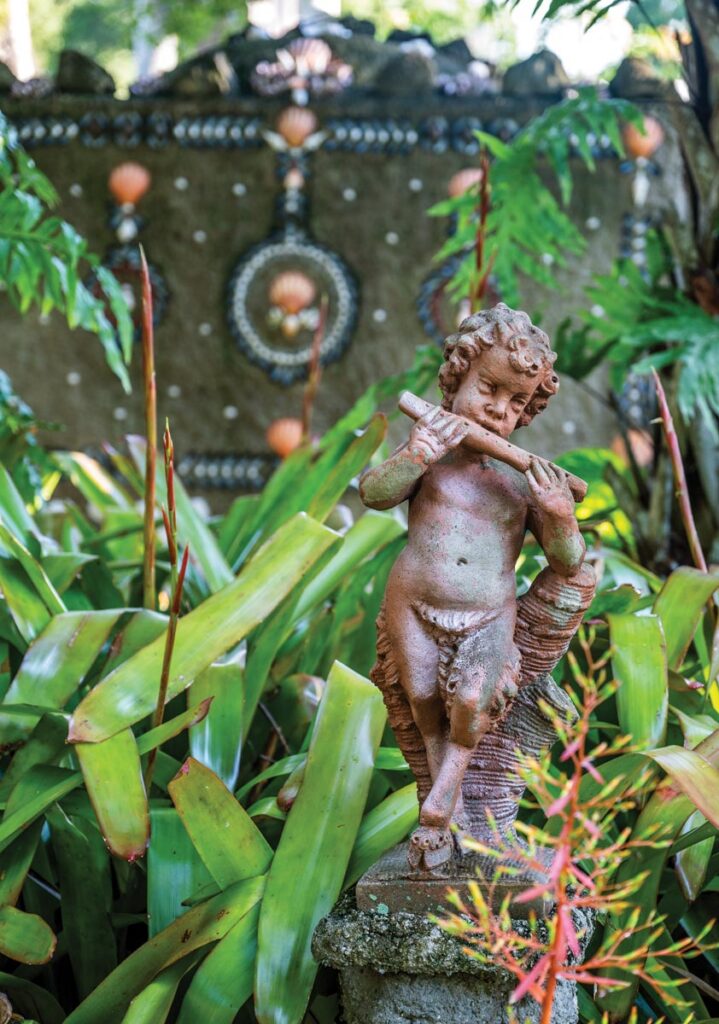
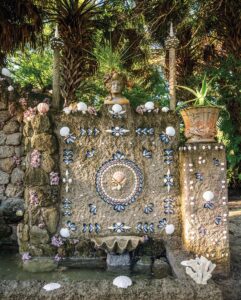
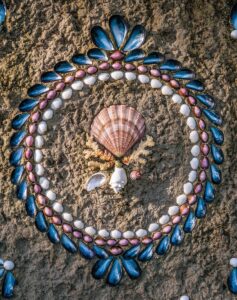
Their garden has its own grotto, complete with a fountain with a seashell theme. The basins of the fountain are shaped like seashells, and the adornment all around consists of inset shells with vibrant colors, placed in intricate patterns. Cathi chose scallop shells for their “iconic shape.” She chose pieces of coral and violet clam shells for varied textures and colors. Blue mussels and purple barnacles add royal hues.
Cathi elaborates: “We made the barnacles part of the construction of the arch for the fountain,” an intricate and challenging aspect of the project that she and Bob worked on side by side. The artistic flair of the fountain and the peaceful flow of the water make this a signature location, so much so that Cathi has named the garden as a whole “Il Giardino della Grotta,” which translates as “The Garden of the Grotto” or “The Grotto Garden.”
The historic Italian gardens that inspired Il Giardino della Grotta include the Boboli Gardens of Florence, known for their beautiful view of Brunelleschi’s dome and for a man-made grotto where some of Michelangelo’s sculptures were displayed. Another favorite place is Isola Bella on Lake Maggiore. Upon the green island amidst the deep blue waters of the lake, a Baroque palazzo rises, its rich interior characterized by pastel hues such as coral, dove gray, and pink. “It’s ethereal,” says Cathi. “And there’s a staircase that leads down into a mysterious grotto.”
Rome and southern Italy have also provided inspiration. Tivoli, near Rome, features the gardens of the Villa d’Este, dating from the Renaissance and Baroque eras, which include the playful “Path of the Hundred Fountains.” Also located at Tivoli are the ancient Roman gardens of Hadrian’s Villa, designed by the eclectic emperor who commissioned the building of the Pantheon. Hadrian’s Villa has innovative water features of its own, including an artificial island adorned with colonnades, where theatrical spectacles may have been performed.
Farther south, in the village of Ravello on the Amalfi Coast, overlooking the turquoise waters of the Mediterranean, are the gardens of Villa Rufolo. With its geometric flower beds and exotic flair, Villa Rufolo was another inspiration for certain features of Il Giardino della Grotta.
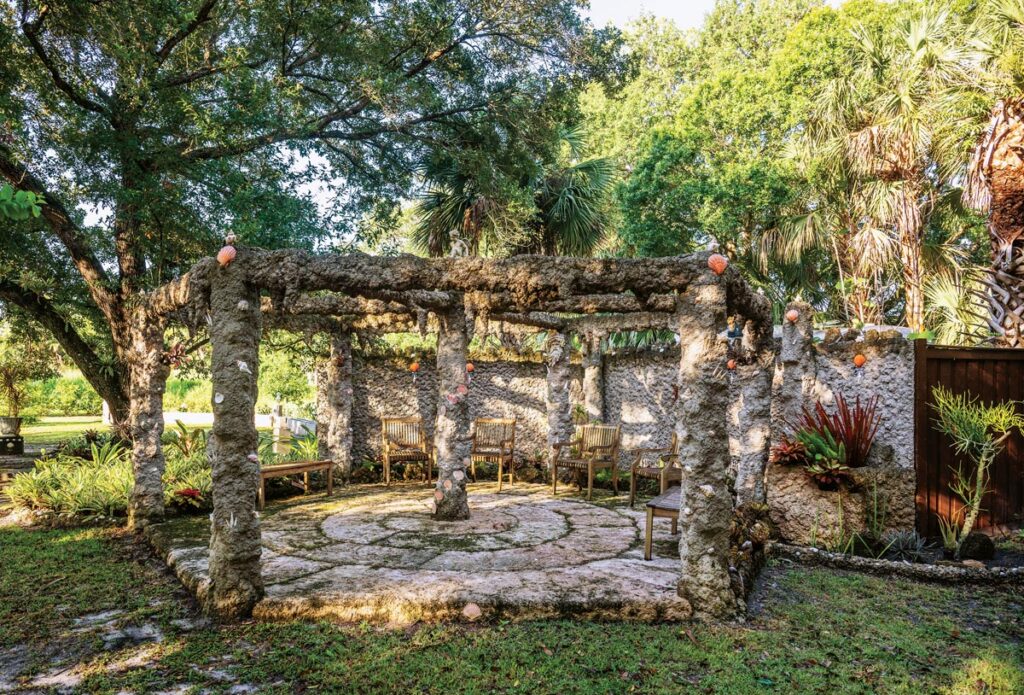
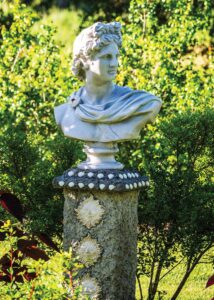
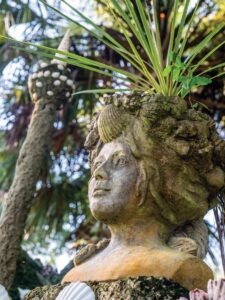
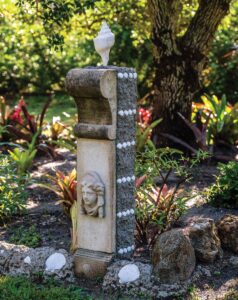
Cathi acknowledges that she does not have a “Medici budget,” so seashells are key decorative features, as “they are natural works of art.” For architectural elements, she has made use of hypertufa, a cement-based substitute for tufa limestone. Given that the ancient Romans invented cement and valued it for its versatility, and given the historical popularity of tufa in the architecture of the Italian peninsula, hypertufa—which combines attributes of both—seems a fitting choice for the garden.
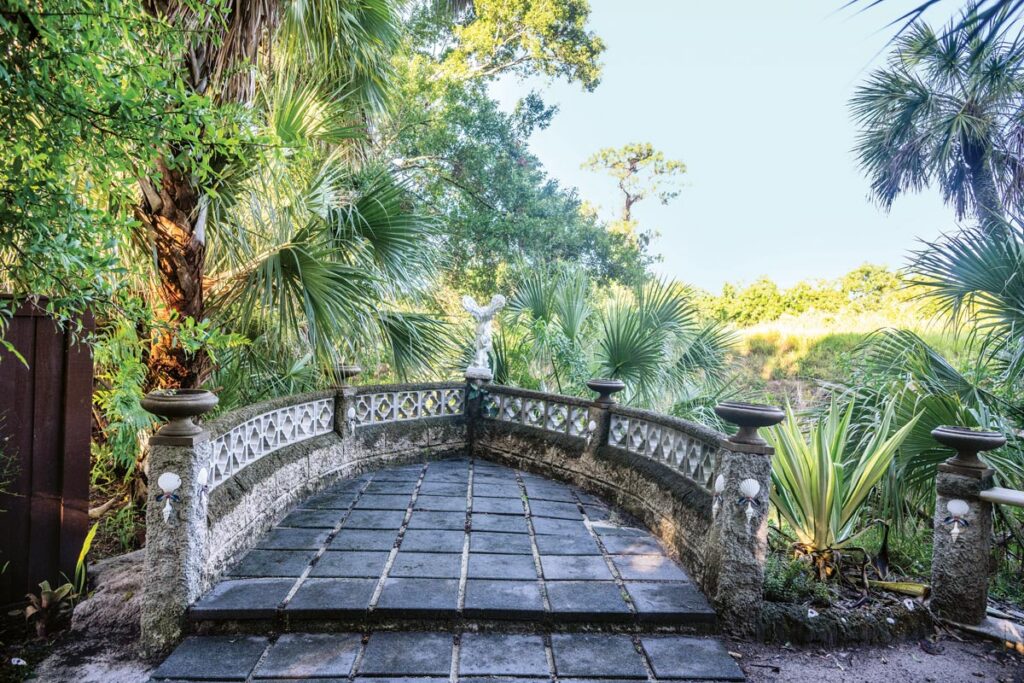
Along with its use in the construction of the grotto, hypertufa was used to build the bow of a ship, which marks another defining feature of the garden. Visitors can stand at the bow and look out at part of the garden as if they are gazing at a green horizon. The ship even has its own figurehead, a classical winged Victory.
Hypertufa columns, set with seashells, form elegant colonnades, and a pavilion serves as a potential gathering place. Cathi has also begun work on a second grotto, which will be even larger; she calls it “La Grotta Grande.” She admits she is in no real hurry to complete it. As with the entire project, she cherishes the journey, not just the destination. “People always ask, ‘What made you build a garden like this?’ And I say, ‘I didn’t really set out to build it.’”
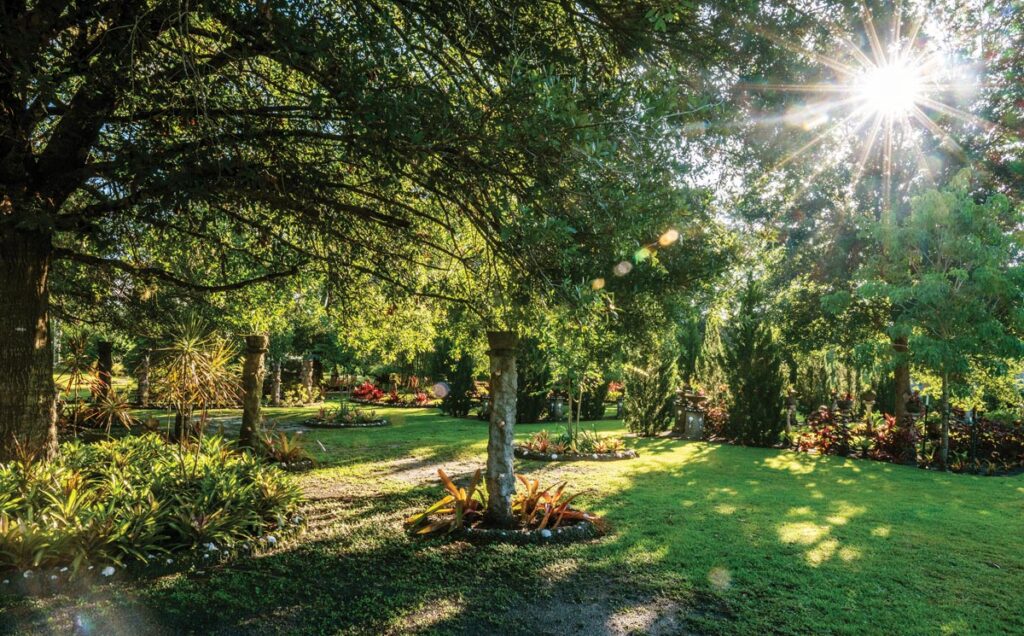
The Mediterranean climate and the Florida climate are both beautiful, but they are not the same; this factor adds to the challenge of garden design. Cathi cannot always use the same species of plants that she has seen in Italian gardens, so she has found interesting substitutions. Italian cypresses, so characteristic of the landscape in Tuscany, are prone to mold in Florida. However, cedar trees have proved to be quite convincing as stand-ins for Italian cypresses, and the cedars thrive here.
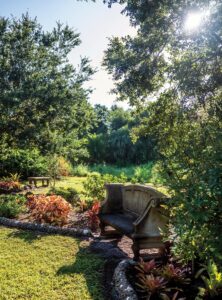
A parklike area of the garden is planted with a variety of bromeliads. Nearby, a “Hong Kong orchid tree” bears blossoms of vibrant light purple, with fragrance that fills the surrounding air. The name of this species, Cathi realizes, is a contradiction in terms; orchids can grow on trees, but they are not themselves part of the tree. However, the flowers of the “Hong Kong orchid tree” resemble orchids, prompting visitors to do a double-take, looking for the spots where they may have been grafted on.
As you might guess, the garden is a haven for wildlife. Visitors include rabbits, a family of barred owls, hawks, hummingbirds, and river otters. Once, Bob even saw what he thinks may have been Florida panther.
Like so much vegetation in the area, the garden was damaged by the unusual frosts this past winter. However, with the perseverance, knowledge, and tender loving care of Cathi and Bob, it will certainly be regenerated.
Visits to the historic gardens of Italy are precious travel memories, and Il Giardino della Grotta is a reflection of adventures past and future. There is also a philosophical depth to Italian garden design that fascinates Cathi. “Italian gardens are about pastoral harmony: humans, plants, and animals together in a landscape.” This idea was celebrated in the pastoral poetry that was popular in ancient Greek and Roman times, and which is the origin of the word “idyllic.” It is a fitting connection, since Italian gardens are idyllic places.

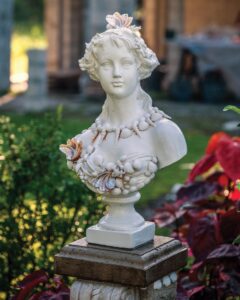
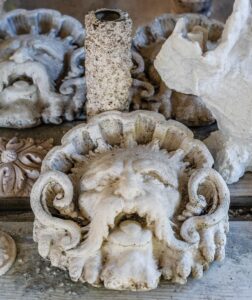
At Il Giardino della Grotta, Cathi and Bob have established a pastoral, idyllic place of their own. With inspiration from Florence, Lake Maggiore, Rome, Ravello, and beyond, they have brought the essence of Italy to Vero Beach, in the form of a beautiful and beloved garden.
Note: In the future, Cathi may open the garden for guided tours two days out of each month. The premises are suited to adults only, and a $20 per person donation would be appreciated. Garden Clubs would be welcome. For more information, or to book a tour, call 772-205-5741.





 True Tails is a series written by Amy Robinson for Vero Beach’s dog lovers. Ask Amy about your dog’s behavior by clicking below.
Facebook Comments